Promotional clothing runs on different economics from retail. The recipient did not choose the garment, is not comparing it on a rail, and will judge it in about two seconds — mostly on whether the print looks right.
That changes almost every specification decision. Here is how.
Weight: lower than you think
For most promotional and event work, 150 GSM is the correct answer.
The instinct to go heavier is a retail instinct, and it does not transfer. Nobody assesses the hand-feel of a shirt they were handed at a conference. What a heavier fabric buys you on a giveaway is cost — twice, once in cloth and again in freight, because sea freight is charged on weight.
Where to spend instead: the print, and the fit. A well-printed 150 GSM tee that fits looks considerably better than a badly printed 200 GSM one.
The exception is anything the recipient is meant to keep and wear — staff clothing, merchandise people actually want. That is retail logic, and 180 or 220 GSM becomes the right question again.
Simplify the artwork before you price it
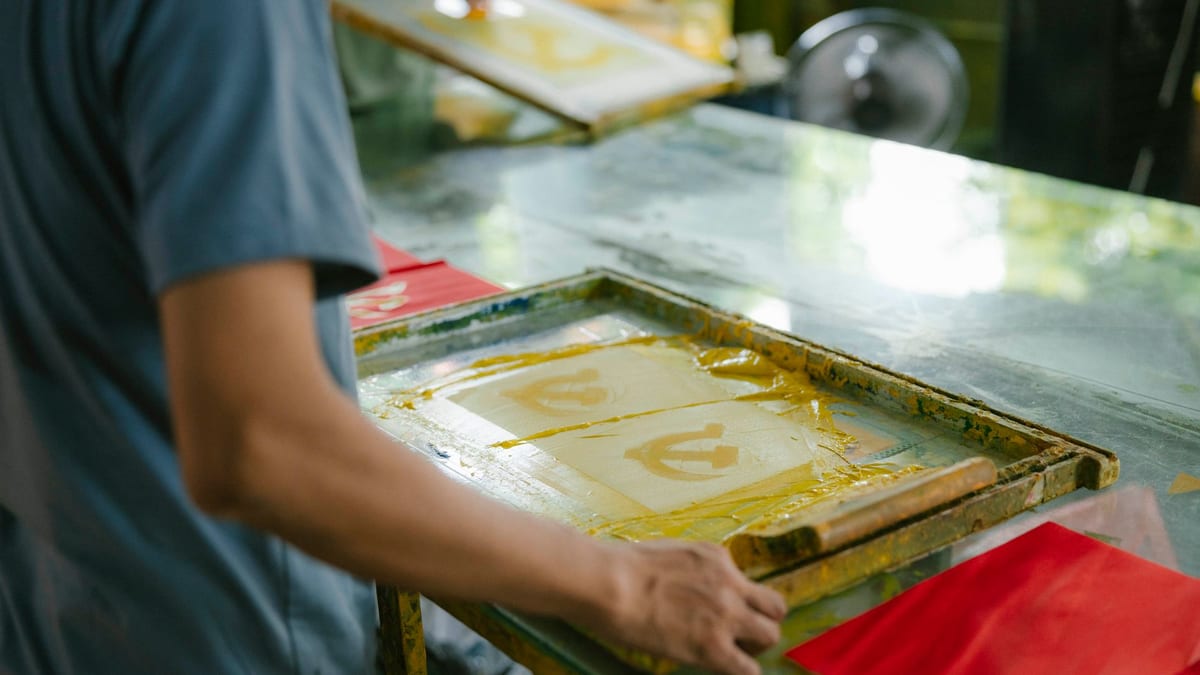
Screen printing is the workhorse for promotional volume, and its cost structure is the thing to design around: each colour needs its own screen, and each screen carries a setup whether you print 300 pieces or 5,000.
So a six-colour logo on a 500-piece run carries six setups spread over 500 garments. The same logo simplified to two colours carries two.
Two things worth doing before you ask for a quote:
- Ask your designer for a two- or three-colour version of the mark. Most logos have one, and on fabric it usually looks better than the full-colour original.
- Check whether a one-colour version exists. For a single-position chest print at volume, it is often the cleanest result and the cheapest.
Two solid colours printed well beats six colours printed cheaply, every time.
Which method for which run
| Run size | Colours | Usually right |
|---|---|---|
| 300+ | 1–3 solid | Screen |
| 300+ | Photographic | DTF, or screen with a simplified redraw |
| Under 200 | Any | DTF — no setup cost |
| Any, on polyester | Any | Sublimation or DTF, never plain plastisol |
That last row matters for sports and event kit. Plastisol on polyester can discolour as the fabric dye migrates into the ink — a white print on a red polyester tee turning pink months later. Choosing a decoration method goes through the trade-offs properly.
Ink choice changes the feel
Even on a giveaway, this is worth one decision:
- Plastisol — opaque, durable, and heavy over a large area. A big plastisol slab feels like a sticker.
- Water-based — softer, sinks into the fibre, less opaque on dark grounds.
- Discharge — removes the garment dye and replaces it with pigment. Excellent hand on dark cotton, and only works on reactive-dyed 100% cotton.
For a small chest logo, plastisol is fine and nobody will notice. For a large front print on a shirt you want people to wear again, water-based or discharge is the difference between a garment and a billboard.
Order the size curve, not equal quantities
The most common promotional ordering mistake: 100 each of S, M, L, XL and XXL.
Real distribution skews heavily to M and L. Equal quantities leaves you with a box of unwanted smalls and a shortage at the sizes people actually took. Ask whoever is distributing what last year’s split looked like; if there is no history, weight the middle and be honest that the curve is a guess.
Do not skip the labelling because it is a giveaway
Promotional garments carry the same market labelling obligations as retail ones. Fibre composition, country of origin, care instructions and importer details all apply whether the shirt was sold or handed out at a stand.
It is worth saying because promotional runs are exactly where this gets forgotten, usually under time pressure. What South African market labelling covers is a short list, and having it applied in the factory costs almost nothing next to relabelling a pallet.
What to send with the enquiry
- Artwork as vector, with colours specified
- Print positions and print size
- Fabric weight and fibre
- Quantity and the size curve
- The date it is needed, working backwards from the event
- Whether the garment is a giveaway or something people keep
That last line changes the recommendation more than anything else on the list.
The step nobody skips twice
Wash-test the print on the pre-production sample. Five domestic cycles.
It is tempting to skip this on a promotional run — it is only a giveaway, after all. But a logo that cracks after two washes is worse than no logo, because it is your client’s brand on it and the garment is now advertising carelessness.
Timing
Promotional work is nearly always tied to a date, so plan backwards: 20–40 days for sampling, 30–45 days production after approval, then 14–18 days sea freight to Durban. That is roughly two to four months before the event, not two weeks.
If you are placing a first order with a new supplier, the questions worth asking first take an afternoon and save the schedule.
Printing runs in our own unit for the methods we hold and at specialist partner print houses for the rest; embroidery is always handled by a partner unit. Decoration is wash-tested before bulk runs. We supply South African promotional distributors and corporate clothing suppliers from 300 pieces per style per colour — send us the artwork and the date and we will tell you what the garment actually needs.
Keep reading
How to choose a t-shirt supplier for South Africa
What actually matters when you are importing tees into South Africa: sea leg, GSM for the climate, shade consistency across repeat orders, and the paperwork your clearing agent will want.
180 GSM or 220 GSM: which weight for the South African market
The two weights most SA orders come down to, and how to choose between them — by end use, by climate, and by what the extra 40 grams costs you in freight.
Buying t-shirts by GSM: a South African buyer's guide
How to specify fabric weight so you get what you ordered — tolerances, the questions that go with the number, and how to compare two quotes that are not quoting the same garment.