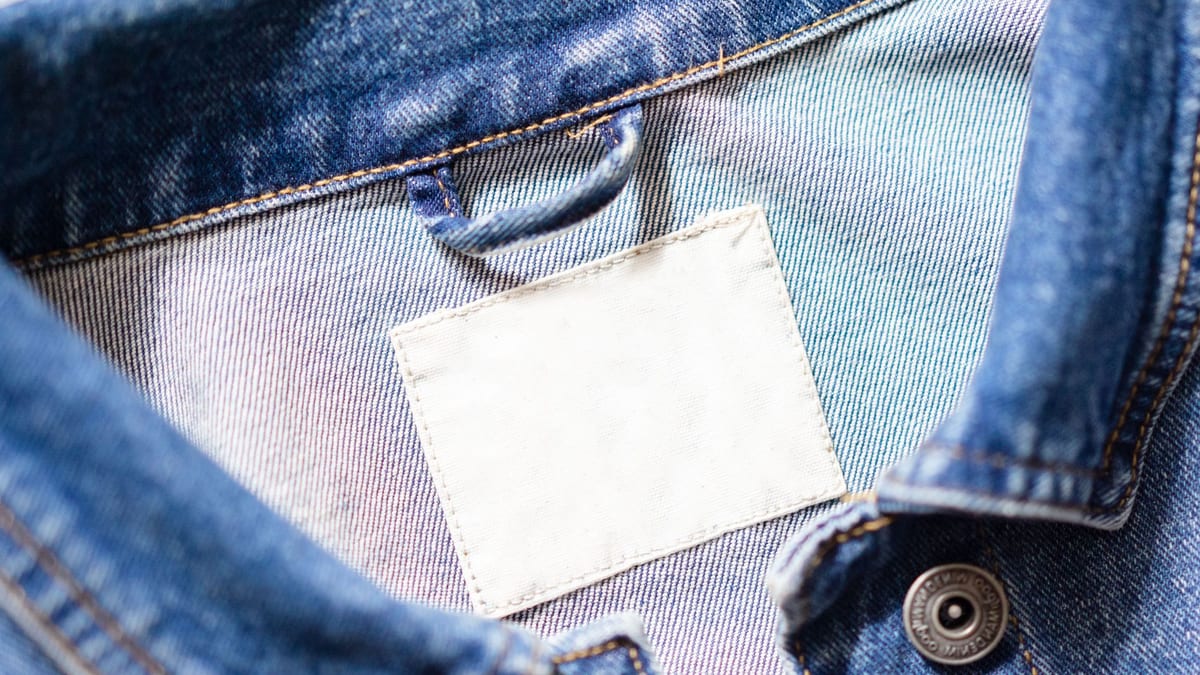
The two terms get used interchangeably and mean genuinely different things. Getting the distinction right matters because one of them has a ceiling and the other does not.
The actual difference
White label — a manufacturer or wholesaler makes a standard garment, and several brands buy the same garment and apply their own branding. The blank already exists. You are choosing from a catalogue.
Private label — a factory makes a garment to your specification. Your fabric, your weight, your fit, your colour, your construction, your labels. Nobody else has that garment.
Between them sits the most common UK setup: buying branded blanks from a wholesaler and printing them yourself. That is white label with an extra intermediary.
What each one actually gives you
| White label / blanks | Private label | |
|---|---|---|
| Minimum | Very low — sometimes single units | 300 pieces per style per colour |
| Lead time | Days | 2–3 months for a first order |
| Fabric and weight | Whatever the blank is | Your specification |
| Fit and block | Fixed | Yours, or patterned from a reference garment |
| Colour | The range on offer | Matched to your Pantone |
| Neck label | The blank supplier’s, or a relabel | Yours, woven or printed |
| Cost per piece at volume | Higher | Lower |
| Ceiling | Real | None |
Why white label is the right start, and the wrong finish
It is the right start because it removes almost all the risk. You can test a design, a market and a price point for the cost of a few dozen garments, and if nobody wants it you have lost very little. Any brand that skips this and orders deep is gambling.
It becomes the wrong finish for four reasons:
The garment is not yours. Your competitor can buy the identical blank. The only thing distinguishing you is the artwork, which is the easiest thing in apparel to copy.
You cannot fix what you do not control. If the collar stretches, the fabric pills or the fit is wrong for your customer, there is no conversation to have. You can only change supplier and start again with a different set of compromises.
Your margin is shared. A blank supplier and often a wholesaler both take a cut before you do.
The neck label gives it away. Customers look at the inside of the collar to decide whether something is a real brand. A blank supplier’s label tells them, correctly, that they bought somebody else’s shirt with your art on it — and it is the cheapest thing to fix.
The cost comparison people get backwards
The assumption is that private label is the expensive option. Per piece, at any reasonable volume, it is usually the cheaper one — you are buying a garment at manufacturing cost instead of at wholesale cost with two margins on it.
What private label costs is not money per unit. It is commitment: a minimum, a lead time, and sampling before you see the result.
So the real question is not “which is cheaper” but “am I confident enough in this style to commit to 300 of it”. If the answer is no, the honest advice is to stay on blanks until it is yes. What that minimum actually commits you to is less than most people assume, but it is not nothing.
What “private label” should include
If a supplier calls it private label, it should mean all of this applied in the factory, not by you afterwards:
- Woven or printed neck label, or a heat-transfer nape print for tagless
- Care label written to UK requirements
- Hang tag
- Polybag with the right warnings
- Barcode stickers and carton marking
That last group is what makes goods retail-ready. If they arrive without it, somebody does it in your warehouse, and that cost never appeared in the quote you compared.
Care labelling in particular is a UK-market question rather than a generic one — what has to be on a UK label is worth settling before the first order rather than at the relabelling table.
A practical sequence
- Validate on blanks. One design, small quantity, real customers.
- Work out your landed cost at private-label volumes before you fall in love with the idea.
- Move the winner to private label, one style, two or three colours.
- Keep blanks for testing new designs. Most established small brands run both permanently.
That last point is the one nobody says out loud: this is not a one-way door, and treating it as an either/or decision is what makes it feel bigger than it is. Nothing stops you carrying a private label core range and testing seasonal designs on blanks alongside it, and most brands that last end up doing exactly that.
If you are still at the stage of choosing who to make it with, finding a manufacturer for a UK brand comes first.
We manufacture private label knitwear in Tirupur for UK brands and wholesalers — your labels, care labels, hang tags, polybags and barcodes applied in our unit, from 300 pieces per style per colour. Send us a reference garment and we will pattern from it, or tell you honestly if you would be better off on blanks for another season.
Keep reading
Choisir un fabricant de T-shirts en marque propre en Inde
Un guide pratique pour les marques françaises : cahier des charges, validation du prototype, partenaires de production et préparation de l’importation.
How to choose a private-label clothing manufacturer for a Spanish brand
A practical sourcing checklist for Spanish apparel brands comparing private-label production in India, from samples and specifications to import planning.
T-Shirts aus Indien einkaufen: Leitfaden für deutsche Marken
Ein Leitfaden für deutsche Marken: technische Spezifikation, Musterfreigabe, Produktionspartner und Importplanung für T-Shirts aus Tirupur.