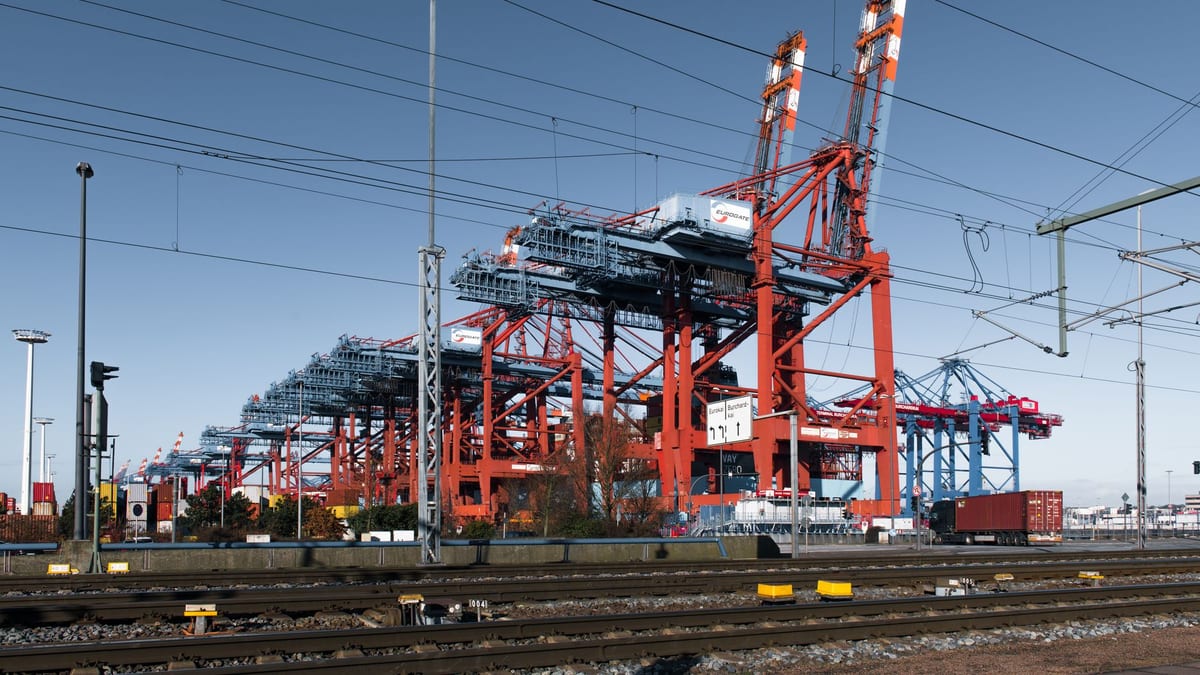
US importers who have sourced from China arrive with a firm instinct: West Coast is the fast route. From South India that instinct is wrong, and acting on it costs a week.
The transit times
Sailing from Tuticorin, Chennai or Cochin, typically:
| Destination | Typical port-to-port |
|---|---|
| East Coast — New York/New Jersey, Savannah, Charleston, Norfolk | 28–35 days, via Suez |
| West Coast — Los Angeles, Long Beach | 30–38 days |
The reason is the routing. From South India the natural path to the US East Coast runs west through Suez, which is a shorter run than crossing the Pacific. From China the geography reverses and the West Coast becomes the short leg.
Both figures are typical rather than guaranteed. Transhipment, blank sailings, canal conditions and carrier schedules all move them, and none of that is inside a factory’s control — which is why we quote a range rather than a date.
The decision is really about inland freight
Ocean transit gets the attention and inland movement usually decides the answer.
Ask where the goods are actually going. If your DC is in New Jersey, discharging in Los Angeles means a container crossing the country by rail, which adds days and cost that never appear on the sailing schedule. If your DC is in Southern California, the reverse applies.
The rough hierarchy:
- Where is the inventory going to sit? Feed the nearest port.
- Is this a single DC or several? Multiple DCs may justify splitting shipments across coasts.
- Is anything time-critical? Then look at air freight rather than optimising ocean by a few days.
The days that do not appear on a schedule
Port-to-port is not door-to-door. Between the two sit:
- Terminal dwell — how long the container waits before it can move
- Drayage — trucking from the terminal to a warehouse or rail head
- Rail transit, if the container is moving inland
- Customs clearance, which is usually fast but not always
These vary by port and by season, and they are exactly what a good forwarder can tell you about your specific lanes. They also swing far more than the 2–3 day difference between coasts, which is why optimising the ocean leg in isolation is usually the wrong focus.
Congestion and risk
Both coasts have had disruptive periods, and both will again. Two practical responses:
Do not build a plan with no slack. If a season depends on a container arriving in a specific week, the plan is fragile regardless of which port you chose.
Consider splitting across coasts for larger programmes. It costs a little efficiency and removes a single point of failure. For a first order this is over-engineering; for a repeating programme it is worth a conversation.
Direct service or transhipment
The question worth asking your forwarder alongside the port: is this a direct service, or does the container transship?
A direct service runs from the load port to the discharge port without the box being lifted onto another vessel. A transhipment routing moves it at an intermediate hub — Colombo, Jebel Ali, Singapore and Salalah are common ones out of South India.
Transhipment is not a problem in itself and a great deal of apparel moves that way. What it adds is variance: an extra handling point is an extra place for a container to miss a connection. If your schedule has no slack, ask whether a direct service exists on your lane and what it costs.
It also explains why two quotes with the same stated transit can behave differently in practice. The number on the schedule is the plan; the routing is what determines how often the plan holds.
Who nominates the port
Your forwarder, on FOB terms — which is one of the practical arguments for taking FOB rather than DDP on anything beyond a first small order. They know current lane performance in a way a factory in Tirupur genuinely does not.
What we control is the port of loading and getting the goods there with a complete document set. What happens after that is your forwarder’s expertise, and you should use it.
Air freight, for the cases that warrant it
From Coimbatore or Chennai, air runs 4–7 days for samples and urgent top-ups. It is expensive enough that it only makes sense for small quantities or genuine emergencies — but for a sample that unblocks an approval, it frequently pays for itself in avoided delay.
Build the whole timeline, not just the sailing
A first order, honestly:
- Quotation: 1–2 working days
- Sampling: 20–40 days per round, plus your approvals
- Production: 30–45 days after sample approval
- Ocean: 28–38 days depending on coast
- Inland and clearance: variable
Two to three months from commitment to sellable stock. Anyone planning six weeks is planning to miss a season — which is the same arithmetic set out in how to find a clothing manufacturer and worth doing before the first order rather than during it.
We ship from Tuticorin, Chennai and Cochin to any major US port, with the commercial invoice, packing list, bill of lading and certificate of origin prepared alongside the consignment. We supply importers and brands across the United States from 300 pieces per style per colour — tell us your destination DC and we will quote to the port your forwarder wants.
Keep reading
FOB or DDP? Choosing terms for your first apparel import
Incoterms decide who arranges freight, who carries the risk and who clears customs. What FOB, CIF and DDP actually mean for an apparel importer, and why two quotes on different terms are not comparable.
How to find a clothing manufacturer (without getting burned)
The order of operations that works: define the garment, shortlist factories, verify them, sample, then place a small first order. Written by a factory, including the parts that are not flattering to us.

What a 300-piece minimum actually costs you
The arithmetic behind a low MOQ clothing manufacturer — what 300 pieces per style per colour really commits you to, what it buys that blanks do not, and when a lower minimum is a warning sign.