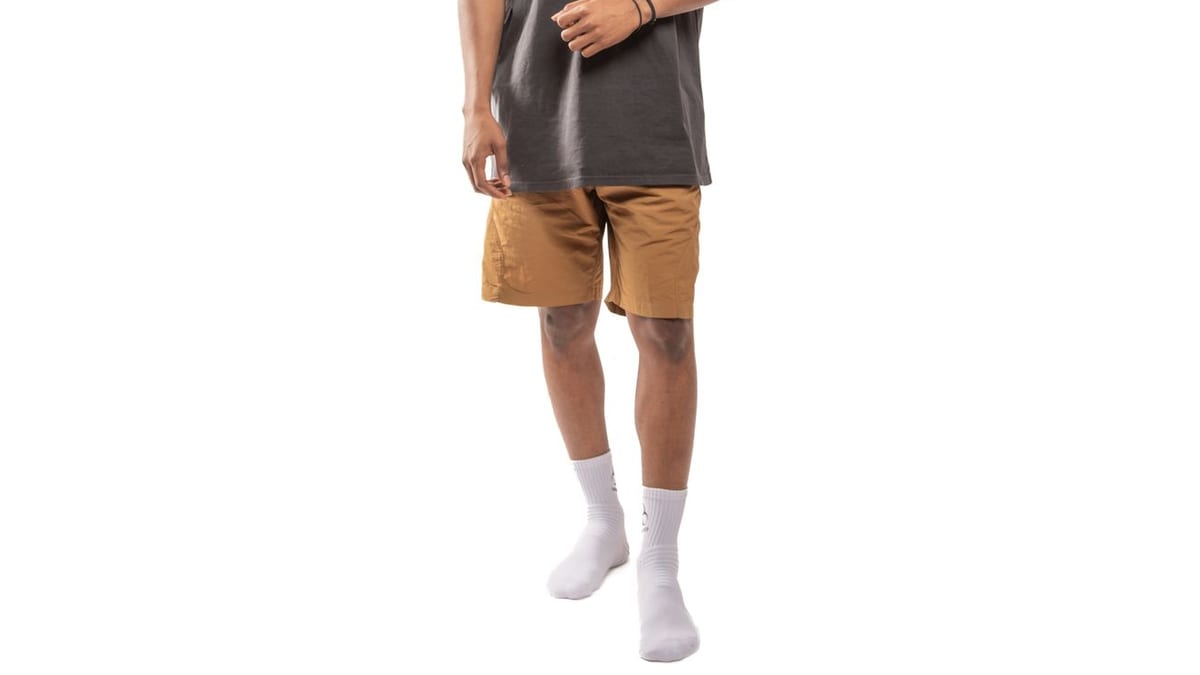
The most common streetwear sampling mistake is ordering an oversized block in the fabric weight you would use for a standard retail tee. The pattern is right, the measurements are right, and the garment still looks wrong — because it drapes off the body instead of hanging from it.
Weight is not a premium signal here. It is a structural requirement of the silhouette.
Why light fabric kills an oversized block
A standard fitted tee gets its shape from the body underneath it. An oversized tee does not touch the body across most of its area, so its shape comes entirely from how the fabric falls.
At 150–180 GSM, single jersey is light enough that the excess fabric clings, creases and follows the wearer. The eye reads that as a shirt that does not fit. At 220 GSM and above, the same pattern holds a line from the shoulder and the volume looks deliberate.
This is why “premium heavyweight tee” became a category. The weight is doing real work, not just signalling.
The working range
| GSM | What it does on an oversized block |
|---|---|
| Under 200 | Clings and creases. Reads as too big rather than oversized |
| 220–240 | The reliable range. Hangs properly, takes a large print, still wearable in warm weather |
| 240–260 | Heavier drape, stronger shoulder line. Where most “heavyweight” positioning sits |
| 280+ | Loop knit and terry territory — closer to a light sweatshirt than a tee |
We run 220–260 GSM heavy single jersey and loop knit for this category. Below 220 we would tell you the block is going to disappoint you, which is a conversation we have had many times and lost a few orders to.
If the GSM logic itself is unfamiliar, what the number measures and what it hides covers it — the short version is that weight is not quality, but for this specific silhouette it is a requirement.
Drop shoulder is a different pattern, not a bigger size
The second common mistake: asking a factory to grade a standard tee up two sizes and calling it oversized.
It does not work, because three things change independently in a real streetwear block:
- The shoulder seam moves onto the upper arm. That is the whole silhouette. Grading up moves it out proportionally, which is not the same thing.
- The armhole deepens and the sleeve widens to match, otherwise the sleeve pulls when the arm lifts.
- Body length and width move at different rates. A boxy block is wider relative to its length than a graded-up standard tee will ever be.
Send a reference garment if you have one. A factory can pattern from a physical sample far more reliably than from a description, and it removes an entire round of sampling.
Print is why the finishing matters
Streetwear is print-led, and a large chest or back print is the least forgiving thing you can put on a knit.
Two finishing steps decide whether it survives:
Compacting and pre-shrinking before cutting. Uncompacted fabric shrinks in the first wash. On a plain tee that means a fit change. Under a 30-centimetre print it means the print distorts, because the ink does not shrink with the cloth. This is not fixable afterwards.
Wash-testing the decoration before the bulk run. Five domestic wash cycles on the pre-production sample. Plastisol, water-based, discharge and DTF all behave differently on heavy jersey than on a light tee, and the only way to know is to wash it. What actually fails at the tenth wash applies here with more force than usual, because the print is the product.
Hand feel is worth deciding deliberately too. A heavy plastisol slab on a 240 GSM tee makes a garment that is stiff in two directions. Water-based and discharge inks sink into the fibre and keep the fabric moving.
What the weight costs you
Two costs, and buyers usually budget only the first.
Cloth. Moving from 180 to 240 GSM is roughly a third more fabric per garment. That flows straight into the piece price.
Freight. GSM is weight, and weight is money in a container. On a 3,000-piece order the difference is real, and on air freight it is punishing. For sea freight from South India to the US — 28–35 days East Coast, 30–38 West Coast — it is usually absorbable, but it belongs in the costing rather than as a surprise on the forwarder’s invoice.
The corollary: do not buy weight the garment does not need. A 240 GSM promotional tee is money spent on something the recipient will not notice.
Starting small on a heavy block
Heavyweight streetwear is a good category to test in small quantities, because the whole proposition is a garment people choose to wear rather than one they were given.
Our minimum is 300 pieces per style per colour on a stock fabric, which for one style in two colourways is a real launch. How the minimum works sets out what that commits, and the wider guide to finding a manufacturer covers the steps before you get to a quantity.
We spec heavy single jersey and loop knit, knitted to our order in Tirupur and compacted and pre-shrunk before it reaches our cutting floor so a large print stays where you put it, and we pattern drop-shoulder blocks from your reference garment or tech pack. We supply streetwear labels across the United States — send us a reference garment and we will quote it properly.
Keep reading
How to find a clothing manufacturer (without getting burned)
The order of operations that works: define the garment, shortlist factories, verify them, sample, then place a small first order. Written by a factory, including the parts that are not flattering to us.
What a 300-piece minimum actually costs you
The arithmetic behind a low MOQ clothing manufacturer — what 300 pieces per style per colour really commits you to, what it buys that blanks do not, and when a lower minimum is a warning sign.

Alibaba alternatives: telling a factory from an agent
Every listing says manufacturer. Here is how to work out which supplier on Alibaba, IndiaMART or a trade show floor actually owns machinery — and where else to look.