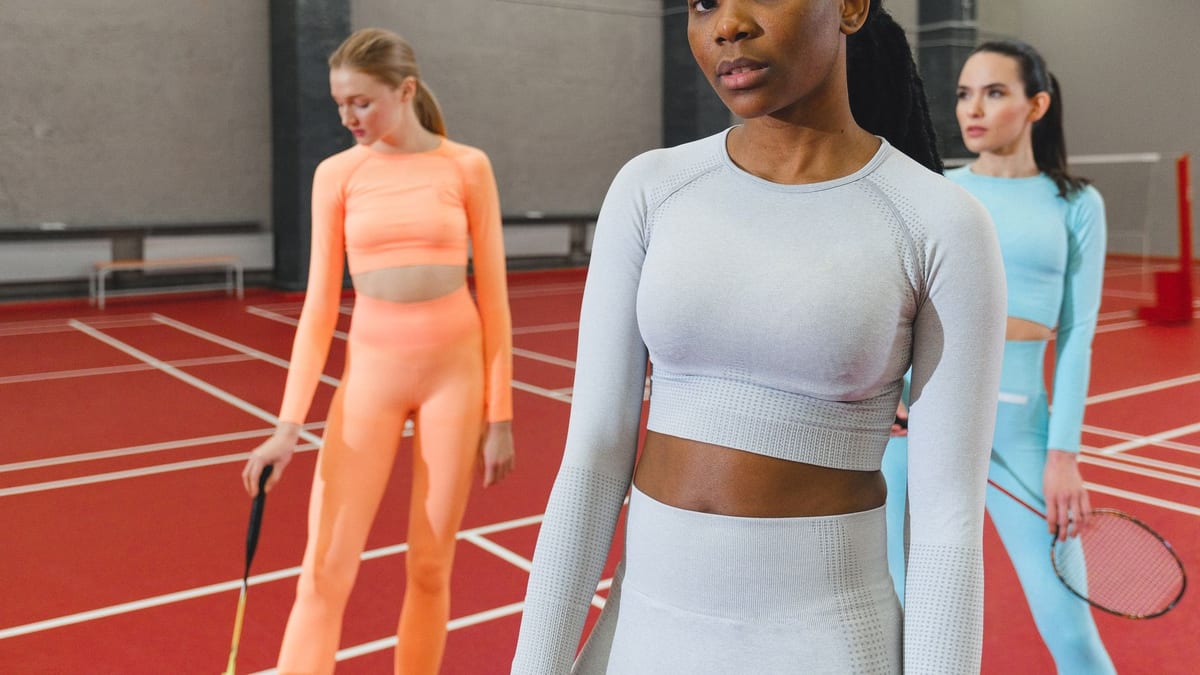
A sportswear tech pack that says “performance fabric, moisture wicking” will get you a quote, and the garment that arrives will be whatever the factory had. Performance knits are less forgiving than cotton, so the specification has to be tighter, not looser.
Here is what actually needs to be on it.
Fibre, and the ratio
“Performance” is not a fibre. Three real options:
| Fabric | What it does | Where it belongs |
|---|---|---|
| 100% micro-polyester | Moves moisture to the surface, dries fast, holds sublimation print | Team kit, running tees, general gym |
| Poly-spandex 88/12 | Adds recovery and stretch in both directions | Leggings, fitted tops, anything close to the body |
| Honeycomb or mesh | Open structure for airflow | Panels, linings, high-heat use |
The ratio matters as much as the fibre. A garment cut in 100% polyester where the design assumed stretch will feel restrictive, and no amount of pattern adjustment fixes that after the fact.
Cotton is not on this list on purpose. It absorbs and holds moisture rather than moving it, which is comfortable at rest and unpleasant under load.
Weight: lower than you think
Our working range for performance knits is 120–180 GSM, and most orders land between 140 and 160.
This is the opposite instinct from cotton retail, where heavier often reads as better. Here, weight works against the fabric’s whole purpose — a heavy performance knit holds more moisture, dries slower and traps heat. When a buyer asks for 200 GSM polyester it is usually because they are applying a cotton mental model to a fabric that does not share its logic.
What a weight figure does and does not tell you is the same argument in every fabric; the right answer is just much lower here.
Seams: flatlock or overlock
The most consequential line on the tech pack, and the one most often left blank.
Flatlock. The seam allowance is butted rather than folded, so the join lies flat against the skin with no ridge. That is what stops chafing on anything worn for a long session or against bare skin. Slower to sew, and it costs more.
Overlock. Standard construction, a small ridge on the inside. Perfectly acceptable for a team tee worn over something else, or for short-wear kit. Cheaper.
The rule of thumb: if it touches skin for more than an hour, flatlock it. Leggings, base layers, long-run tops. For a training tee worn twice a week, overlock is not a compromise, it is the right call.
Specify the thread too. Polyester thread on polyester fabric — cotton thread on a stretch garment will break at the seam before the fabric fails.
Decoration: not plastisol
This is where sportswear orders go wrong most expensively, because the failure appears months after delivery.
The problem: polyester is dyed with disperse dyes, which can migrate into a print over time and under heat. A white plastisol print on a red polyester tee turns pink. Nobody notices at inspection; everybody notices at week twelve.
The routes that work:
- Sublimation. The ink becomes part of the fibre. No hand-feel at all, unlimited colours — and it only works on polyester, and only on light grounds.
- DTF. Good on blends and on dark grounds, holds fine detail, sits on the surface.
- Plastisol with a proper blocker base, if screen printing is genuinely required. It works, it costs more, and it needs testing.
Whichever you pick, wash-test the decoration on the pre-production sample before the bulk run. Five domestic cycles. On performance fabric this is not optional — the failures that lose repeat customers show up in the wash, not on arrival.
Fit details that belong on the pack
Sportswear has construction features cotton tees do not, and each needs stating:
- Raglan or set-in sleeve — raglan gives shoulder movement, set-in gives a cleaner line
- Mesh side panels or underarm ventilation, and where
- Reflective piping or print, if the garment is for outdoor use
- Laser-cut ventilation, where the design calls for it
- Hem finish — coverstitch, raw-edge or bound
- Gusset on anything with a leg
We grade XS–3XL across men’s, women’s and youth blocks. A women’s performance top is not a small men’s one — armhole, shoulder slope and length all differ, and grading across is visible immediately to whoever is wearing it.
If it is children’s sportswear
Everything above applies, plus the children’s rules. Cords in particular: a hood or waist cord on a child’s activewear is exactly the case BS EN 14682 is concerned with, and the safest answer is to design it out rather than manage it.
Confirm current requirements with your own testing house. The wider children’s wear questions cover trims, traceability and labelling alongside it.
A minimum tech pack for performance wear
If you send nothing else, send this:
- Fibre and ratio — e.g. poly-spandex 88/12
- Weight with tolerance — e.g. 150 GSM ±5%, finished
- Seam type, per seam — flatlock or overlock
- Decoration method, positions and colours
- Size chart, and which block: men’s, women’s or youth
- Construction features — raglan, panels, gusset, hem finish
That is enough for a quote that means something, and enough to compare two quotes honestly.
We run performance knits as a separate line from cotton in our Tirupur unit — micro-polyester, poly-spandex and mesh, flatlock or overlock, sublimation and DTF decoration, from 300 pieces per style per colour. We supply UK sportswear and teamwear brands — send a tech pack or a reference garment and we will quote against it properly.
Keep reading
Children's clothing manufacturers: what to ask before you order
Children's garments carry obligations adult ones do not — cords, trims, labelling and traceability. The questions a UK buyer should ask a factory before placing an order, and what a good answer sounds like.
Streetwear manufacturing: why oversized blocks need heavier fabric
An oversized tee cut in 160 GSM does not look oversized, it looks too big. What a streetwear block actually requires from the fabric, the pattern and the print — and what it costs in freight.
What GSM actually means when you're buying T-shirts wholesale
GSM is the number every supplier quotes and most buyers misread. Here is what it tells you, what it hides, and the weight to pick for each kind of garment.